Read Time: 11 min
Knowing the right questions to ask a pole building contractor in Pennsylvania is the difference between a building that lasts for decades and one that brings surprise change orders, permit delays, and leaks you end up paying for. Whether you’re planning a workshop, a multi-car garage, or a hobby shop, the lowest number on a bid sheet rarely tells the whole story.
Post-frame construction in Pennsylvania has to account for heavy wet snow, freeze-thaw cycles, frost depth requirements, and permit rules that change from one township to the next. Not every crew with a post-hole auger is set up to handle all of that.
This guide covers the questions to ask before you sign, what good answers sound like, and the red flags that should send you to the next bid.
TL;DR / Quick Summary
Price alone won’t tell you whether a pole building contractor will deliver a sound, code-compliant building. Their answers on registration, permits, materials, and warranty will.
Key Takeaways:
- Verify the contractor’s PA Home Improvement Contractor (HIC) registration and insurance.
- Get in writing who pulls permits and schedules inspections.
- Require exact specs: UC4B posts, steel gauge, paint system, and lumber grade.
- Insist on a written workmanship warranty, not a verbal promise.
- Keep deposits within Pennsylvania’s legal limit and tie payments to milestones.
Licensing, Insurance, and Warranty Questions
Before you talk door placement or paint colors, confirm you’re dealing with a legitimate, insured business. If an uninsured worker is hurt on your property, the claim can land on your homeowner’s policy.
What is your PA HIC registration number?
Pennsylvania’s Home Improvement Consumer Protection Act (HICPA) requires contractors who perform $5,000 or more in residential home improvements per year to register with the Office of Attorney General. Ask for the number and look it up in the Attorney General’s contractor registry.Keep in mind that HICPA covers residential work, so it applies to a garage or shop at your home but not to a purely commercial project.
Can your insurance agent send certificates directly to me?
A paper certificate handed over at the first meeting can be out of date by the time work starts. Ask for an ACORD certificate of insurance sent directly from the contractor’s agent, listing you as certificate holder. As a practical benchmark, look for:
- General liability: at least $1,000,000 per occurrence, well above the minimum state law requires
- Workers’ compensation: active coverage for every crew member on your site
What does your workmanship warranty cover, and for how long?
Manufacturer warranties cover product defects like paint failure or rust-through. They don’t cover installation mistakes such as bad flashing, loose fasteners, or a door that racks out of square. That’s what a workmanship warranty is for, and terms vary widely from builder to builder.
Ask whether the warranty covers roof leaks, settling, door operation, and wind-damaged trim, how quickly warranty calls get a response, and whether the terms are written into the contract. At Rocky Mountain Contractors, we back our workmanship with a 10-year warranty, and we’re GAF Certified for roofing.
Permit, Foundation, and Site Preparation Questions
A pole building is only as sound as what’s happening below grade, and only as legal as the paperwork behind it.
Who handles zoning, building permits, and inspections?
Requirements vary by township. Depending on where you build, you may need a zoning permit, a building permit under the Pennsylvania Uniform Construction Code (UCC), a stormwater plan, or a PennDOT highway occupancy permit if a new driveway meets a state road.
Not every structure requires a state-level Uniform Construction Code (UCC) building permit in Pennsylvania. Under the Pennsylvania Construction Code Act (Act 45 of 1999), qualifying agricultural buildings used exclusively for farming operations are fully excluded from the UCC. Additionally, the state UCC excludes one-story detached residential accessory structures (such as carports, private garages, greenhouses, and sheds) under 1,000 square feet from construction code scope. However, because Pennsylvania allows local municipalities to modify these rules, most jurisdictions enforce a much lower permit-free threshold (frequently 200 square feet), and local zoning, stormwater, and environmental permits still apply universally regardless of a structure’s size.
Ask who prepares the application, provides engineered drawings, and schedules inspections. Be cautious if a contractor suggests you apply as an owner-builder instead (more on that below).
Read Our Guide to Zoning for more information.
How deep do you set posts, and how do you prevent frost heave?
Posts need to bear below the frost line so freeze-thaw cycles can’t push them up. Plan on a 40-inch frost depth in Central Pennsylvania, and confirm the official requirement with your township’s code official. Ask:
- Hole depth: Will every post bear below 40 inches?
- Footing: Is there a poured concrete footing under each post, or does the post sit on bare soil?
- Post protection: Are posts direct-burial treated lumber, wrapped, or set on concrete piers with wet-set brackets?
What site preparation is included in your price?
A building pad should be level within 1 to 2 inches across the footprint, or framing and doors will fight you for the life of the building. Ask whether excavation, topsoil removal, and compacted stone base (typically 2A modified) are in the base quote or billed separately, and who manages drainage during construction.
Material and Framing Questions
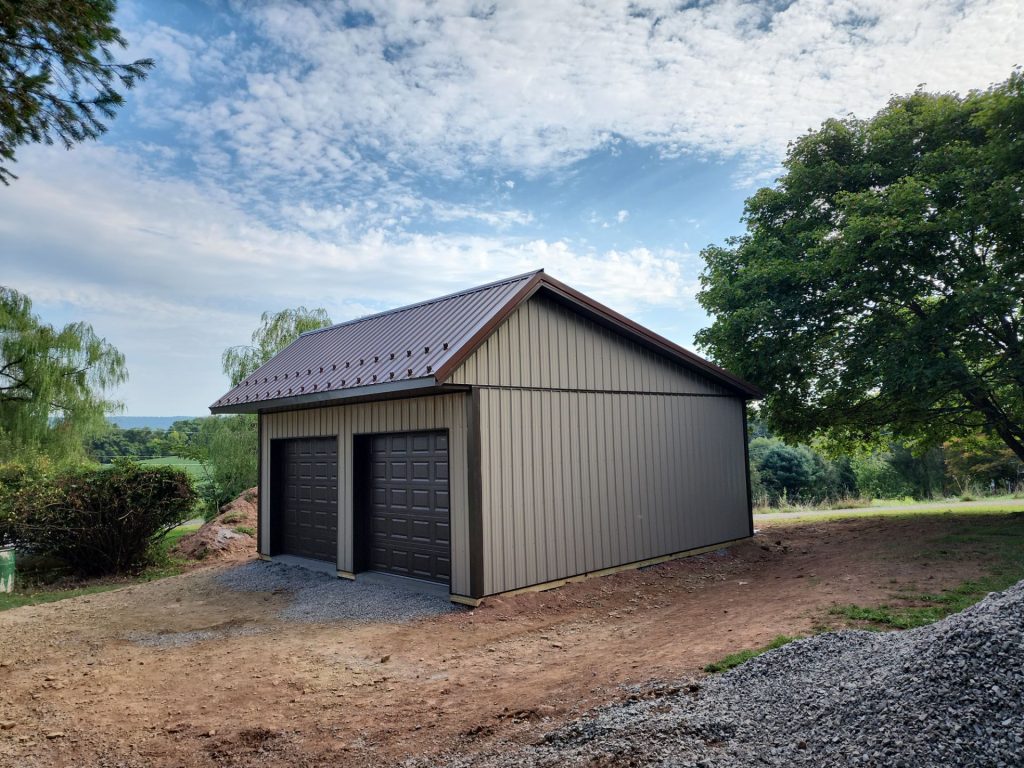
Two buildings with the same dimensions can differ by thousands of dollars in materials. Vague line items are where that difference hides.
What steel gauge and paint system are you using?
“Metal roof and sides” isn’t a specification. Ask for:
- Gauge: 29-gauge is common for residential buildings; 26-gauge is heavier and more dent-resistant.
- Paint system: Silicone-modified polyester (SMP) coatings typically carry longer fade and chalk warranties than standard polyester.
- Fasteners: Painted screws with sealing washers, installed to the panel manufacturer’s pattern.
What lumber grade and treatment are you installing?
- In-ground posts: Pressure-treated to AWPA Use Category UC4B, the heavy-duty ground-contact category. UC4A is meant for general ground contact, not structural building posts.
- Framing lumber: Ask for the species and grade of girts and purlins, and confirm they match what the building engineering calls for.
- Trusses: Ask for engineered truss drawings designed for the snow and wind loads at your site.
What are the specs for the concrete floor?
If a slab is in the contract, “4-inch concrete floor” isn’t enough. Ask for the mix strength (3,500 to 4,000 PSI is common), vapor barrier thickness (10-mil minimum), reinforcement type, and control joint spacing (8 to 12 feet on a 4-inch slab).
Timeline, Payment, and Change Order Questions
Most contractor disputes come from mismatched expectations about schedule and money. Settle both before you sign.
When can you start, and what could delay the job?
Ask for a realistic start date and what it depends on. As general ranges, township permit reviews often take a few weeks, and engineered trusses can take several weeks to manufacture. Frozen or saturated ground can also delay site work.
What does your payment schedule look like?
Under HICPA, a contractor generally can’t take a deposit of more than one-third of the contract price plus the cost of special-order materials for a project that costs over $5,000, and you have three business days to cancel a signed contract. A request for 40% to 50% down is a serious red flag. A milestone schedule might look like this:
- Contract signing: 10%
- Materials delivered and site work complete: 30%
- Framing complete: 30%
- Roof, siding, and doors installed: 20%
- Final walkthrough and punch list complete: 10%
How do you handle change orders and surprises?
If the auger hits ledge rock or an unmarked utility line, who pays? Your contract should state that no extra work proceeds without a signed change order showing the added scope and cost.
What You Can Handle vs. When to Call a Pro
Sweat equity can stretch a budget, but structural work done wrong can void warranties and fail inspection.
Tasks Most Homeowners Can Do
- Staking and planning: Flagging building location, setbacks, and driveway approach before site meetings.
- Interior storage: Building workbenches and shelving once the building is complete.
Tasks for Confident DIYers
- Insulation and liner panels: Requires basic carpentry skills and attention to vapor control.
- Light site clearing: Brush and small-tree removal, if you have experience with rented equipment.
When to Call a Professional
- Post setting and layout: Setting posts plumb, square, and below frost depth takes laser layout tools and heavy equipment.
- Truss setting: Lifting long trusses overhead carries serious fall and crush hazards.
- Large slab pours: Finishing a big slab requires a coordinated crew working within a tight time window.
- Red flags requiring immediate professional attention: posts shifting or heaving, doors that suddenly bind, a sagging roofline, or water pooling at post bases.
Common Pole Building Contractor Red Flags

1. The One-Page Lump-Sum Estimate
What people do wrong: Choosing the builder whose quote is a single line with a building size and a total price.
Why it’s a problem: Footings, door framing, trim, ventilation, and site work go unlisted, then show up later as extras.
The right approach: Ask for an itemized proposal listing post size, truss design loads, steel gauge and paint system, fasteners, and warranty coverage.
2. Pushing the Permit Onto You
What people do wrong: Agreeing to apply as an owner-builder because the contractor says it’s faster or cheaper.
Why it’s a problem: You become responsible for code compliance and inspections, and you lose leverage if the work doesn’t pass.
The right approach: Have the contractor apply and list their PA HIC number on the paperwork.
3. A Verbal-Only Warranty
What people do wrong: Accepting “if anything leaks, just give me a call.”
Why it’s a problem: Verbal promises are hard to enforce, and manufacturer warranties exclude installation errors.
The right approach: Get the workmanship warranty in writing, attached to the contract, with coverage and length spelled out.
Questions Checklist for Your Contractor Meeting
Bring these to your contractor meetings:
- What is your PA HIC registration number?
- Can your agent send insurance certificates directly to me?
- What does your written workmanship warranty cover, and for how long?
- Who handles zoning, building permits, and inspections?
- How deep are posts set, and what footing is under them?
- What lumber grade and treatment (UC4B) are you using?
- What steel gauge and paint system are on the roof and walls?
- What concrete strength, vapor barrier, and reinforcement are included?
- What is your payment schedule and deposit?
- Can I contact three local clients whose buildings are at least two years old?
Conclusion
The contractor you choose matters more than the lowest number on a bid sheet. Verify registration and insurance, get permit responsibility and material specs in writing, and don’t sign without a written workmanship warranty and a payment schedule tied to real progress.
Rocky Mountain Contractors is a family-owned builder based in Dalmatia, building custom pole buildings and custom garages across the Susquehanna Valley, with our workmanship backed by a 10-year warranty. If you’re planning a new building, we’re happy to talk through your plans. Contact us or call (717) 979-5005.
Serving Dalmatia, Sunbury, Shamokin Dam, Lewisburg, Danville, Bloomsburg, Buckhorn, and the surrounding Susquehanna Valley area.
Frequently Asked Questions
What questions should I ask a pole building contractor before hiring?
Start with their PA HIC registration number, insurance certificates sent from their agent, and who handles permits. Then ask about post depth and footings, UC4B post treatment, steel gauge and paint system, the payment schedule, and whether the workmanship warranty is in writing.
Do I need a permit for a pole building in Pennsylvania?
Usually, but not always. Most pole buildings need a UCC building permit, and many also need a zoning permit. Qualifying agricultural buildings and certain detached residential accessory structures under 1,000 square feet are exempt from UCC building permits, though zoning rules may still apply. Check with your township before you build.
How deep do pole building posts need to be in Pennsylvania?
Posts must bear below the frost line, which is usually around 40 inches in Central Pennsylvania. Your township’s code official sets the official requirement. Posts should rest on a concrete footing rather than bare soil to resist settling and frost heave.
What is the difference between a material warranty and a workmanship warranty?
A material warranty comes from the manufacturer and covers product defects like paint failure or rust-through. A workmanship warranty comes from the contractor and covers installation, such as flashing leaks, settling, and door alignment. Workmanship terms vary widely, so get yours in writing.
How much of a deposit is normal for a pole building?
Pennsylvania’s HICPA generally limits deposits on residential home improvement contracts to one-third of the contract price plus the cost of special-order materials. Many contractors ask for less. Remaining payments should follow milestones such as material delivery, framing, and enclosure.
Should I build a pole building or a stick-built garage?
Both work well in Pennsylvania. Single-story stick-built garages achieve the same open, clear-span interiors as post-frame buildings without interior load-bearing walls, and they’re often faster and easier to insulate and finish. The right choice depends on size, use, and finish plans, so work with a builder who does both.
Related Resources
- Custom Pole Building Design Ideas: Styles, Finishes & Features
- Post-Frame and Stick-Frame: Choosing the Right Construction Method for Your Property
- The Complete Guide to Custom Pole Buildings in Pennsylvania
Sources
- Pennsylvania Office of Attorney General — Home Improvement Consumer Protection — HIC registration, deposit limits, and right to cancel under HICPA.
- Pennsylvania Department of Labor & Industry — Uniform Construction Code — UCC permitting and exemptions, including Act 45.
- American Wood Protection Association — Use Category System (UC4A / UC4B) for ground-contact treated wood.