
Read Time: 6-8 min
Building a custom pole barn or workshop is an exciting investment, but in Pennsylvania, the “paperwork phase” often feels more daunting than the construction itself. Between the statewide Uniform Construction Code (UCC) and the specific zoning quirks of Northumberland and Montour counties, knowing exactly which permits you need is the first step to a successful build.
At Rocky Mountain Contractors, we’ve spent over 22 years navigating local building departments from Dalmatia to Bloomsburg. We know that a missing permit doesn’t just delay your project—it can lead to costly fines or issues if or when you eventually try to sell your property.
TL;DR / Quick Summary
Navigating PA building permits requires balancing state-level safety codes with local township zoning laws regarding setbacks and land use.
Key Takeaways:
- Most pole buildings over 1,000 sq. ft. require a full UCC building permit.
- Zoning permits are required regardless of size to ensure proper property setbacks.
- Stormwater management plans are often triggered by the “impervious surface” of a new roof.
- The permit process typically takes 4–7 weeks from application to issuance.
- Zoning variances may be required if your site has unique easement or setback challenges.
- Rocky Mountain Contractors provides free blueprints to simplify your application process.
Zoning vs. Building Permits: What’s the Difference?
In Central Pennsylvania, you generally need two distinct approvals before we can break ground.
Zoning Permits focus on where the building sits on your land. Local townships in Northumberland County have “setback” requirements—minimum distances from your property lines, septic fields, and the center of the road. Even a small shed usually needs a zoning permit to prove you aren’t building over a utility easement.
Building Permits (UCC) focus on how the building is constructed. This ensures the structure can handle Pennsylvania snow loads (typically 30–40 lbs per sq. ft. in our region) and high winds. When you are crafting your perfect pole building design, these structural requirements should be the first thing you consider to ensure your plans are actually buildable.
The 1,000 Square Foot Rule in Pennsylvania
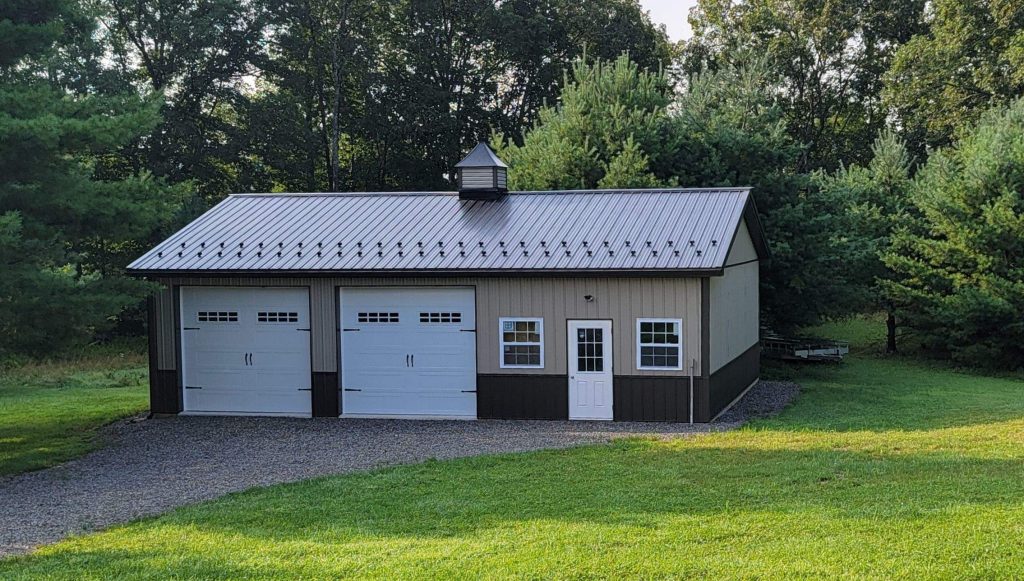
Under the PA Uniform Construction Code, many “unconditioned” residential accessory structures (like a cold-storage pole barn) are exempt from the full building code if they are under 1,000 square feet.
However, this exemption is often misunderstood:
- You still need a zoning permit, even if you are under the 1,000 sq. ft. limit.
- Electrical work always requires a permit, regardless of the building’s size.
- Commercial or agricultural exemptions vary. If you are building agricultural pole barns for a farm, you may qualify for specific exemptions, but you must still file the proper affidavits with your municipality.
The Permit Timeline: A Week-by-Week Breakdown
Understanding the timeline helps you plan your site prep and delivery. While every township moves at its own pace, a typical Central PA permit schedule looks like this:
- Week 1: Site Survey & Design: We finalize your free blueprints and you gather your property plot plan.
- Week 2: Zoning Submission: You submit the zoning application to the township. Most local offices (like those in Sunbury or Lewisburg) review these within 7–10 business days.
- Weeks 3–5: UCC Plan Review: If your building is over 1,000 sq. ft., your plans go to a third-party agency (like Code Inspections, Inc.). They check for snow load engineering and post-depth compliance.
- Week 6: Stormwater & Final Approval: If a stormwater plan is required, this is usually the final hurdle before the permit is “pulled” and construction can begin.
Common Zoning Hurdles: Setbacks and Variances
Not every property is a perfect square. We often encounter two specific hurdles in the Northumberland area:
- Easements: These are “no-build” zones where utility companies have the right to access lines. Building a pole barn over a buried gas line or under a high-tension power line is a safety violation that zoning will catch immediately.
- Variances: If your property is narrow and you cannot meet the standard 20-foot side-yard setback, you may need to apply for a variance. This involves a public hearing where you ask the township for an exception. In our experience, having professional blueprints makes these hearings much smoother because the board can see exactly what you intend to build.
Stormwater Management & Impervious Surfaces
One of the most common “hidden” costs in PA construction is stormwater management. When you add a large metal roof to your property, you create “impervious surface”—area where rain cannot soak into the ground.
According to the Pennsylvania Department of Environmental Protection (DEP), managing runoff is critical for preventing erosion and protecting local watersheds. In areas like Lewisburg or Danville, adding more than 1,000 to 2,000 sq. ft. of new impervious surface often triggers a requirement for a stormwater plan. This might involve installing a dry well or a rain garden to manage runoff. In our experience, addressing this during the design phase with our free blueprints prevents “stop-work” orders later on.
What You Can Handle vs. When to Call a Pro
Tasks Most Homeowners Can Do
- Initial Research: Visiting your township office to ask for a “Permit Packet” and a list of local setbacks.
- Site Sketch: Drawing a basic bird’s-eye view of your property showing where you want the building to go.
Tasks for Confident DIYers
- Zoning Applications: Filling out the basic forms for structures under 1,000 sq. ft. that don’t require engineered drawings.
When to Call a Professional
- UCC Building Permits: Anything requiring structural calculations for snow and wind loads.
- Engineered Blueprints: We provide these for free because we know that “hand-drawn” plans are rarely accepted for larger custom pole buildings in PA.
- Red flags requiring immediate professional attention: If your township mentions “Wetlands,” “Floodplains,” or “High-Density Runoff,” you need a professional contractor to handle the permitting and site prep.
Conclusion
Securing the right permits is the foundation of a stress-free build. By understanding the 1,000 sq. ft. rule and your local zoning setbacks, you can avoid the most common pitfalls of Pennsylvania construction.
If you’re ready to start planning, we’re happy to help. We provide free blueprints with every project to ensure your permit application is professional and accurate from day one. Contact us today to discuss your project.
Frequently Asked Questions
Do I need a permit for a pole barn on a farm in PA?
Yes, you generally still need a zoning permit. While “Agricultural Buildings” are often exempt from the structural requirements of the UCC building code, you must still prove the building meets property setbacks and land-use rules.
How much does a building permit cost in Northumberland County?
Costs vary by township, but typically range from $200 to $800 depending on the square footage and the complexity of the inspections required.
Can I build a pole building myself in PA?
Yes, but you are still responsible for all permits and inspections. If the building includes electricity or plumbing, those specific trades must be inspected by a certified official to ensure safety.
What happens if I build without a permit in Pennsylvania?
Townships can issue “Cease and Desist” orders, double your permit fees as a penalty, or in extreme cases, require you to dismantle the structure if it violates zoning setbacks.
Sources:
- PA Department of Labor & Industry — Official guide to the PA Uniform Construction Code (UCC).
- PA Department of Environmental Protection — Stormwater management and impervious surface regulations.
Serving Northumberland, Danville, Lewisburg, Bloomsburg, Catawissa, and the surrounding Central Pennsylvania area.